Around the Grounds with HIPPY Goodna Team
Conversation with HIPPY Program Coordinator, Wenchi Hu at Goodna, Play Matters Australia.
The Goodna Method: Role play, relational safety, and lived experience experts
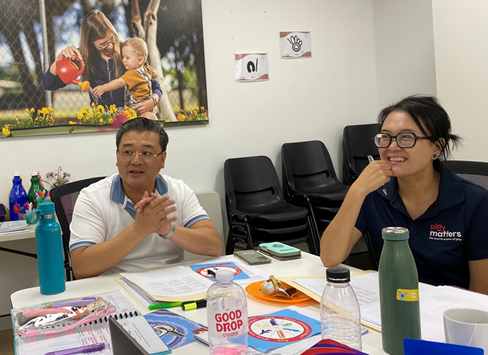
This month, we sat down with the team at HIPPY Goodna's Program Coordinator, Wenchi Hu, and Age 4 Tutors Michael and Anne, to discuss their unique operational model. We chatted about their personal Tutor journeys and how their personal histories as HIPPY parents during the 2020 lockdowns now inform their unique approach to high-impact delivery, leadership, and community engagement.
What immediately stands out is the rapport both the Tutors share, as well as Wenchi's natural leadership style of putting the best skills in the right places and enabling them to create the magic.
You both started the HIPPY journey during COVID times. Reflect on that time, navigating the pandemic in your living room.
How did HIPPY help you?
"I did HIPPY with two boys during the height of the 2020 lockdowns," Anne reminisces. "I had a newborn at the time, and juggling three children was overwhelming."
HIPPY provided a vital routine; the curriculum mirrored what my son was learning in his online kindy sessions
"When physical school resumed, my son thought, ' Oh, I know this, I do that in HIPPY,' and the teachers also noticed HIPPY's overlap and benefits because he was learning the same things. I thought he was kind of ahead of his peers." She remarks, silently proud and shy all at once.
Michael adds, "I was solo parenting during those same lockdowns. I felt isolated, but HIPPY connected me through letterbox drops and phone appointments. It gave me a profound sense of purpose."
HIPPY provided a lifeline of routine when everything else felt broken
"And I agree with Anne as well. When you’re doing HIPPY at home, it ties in with ELF, Early Learning Framework, and when they were going back to kindy, they were already familiar with the learning."
I'm hearing that at one point you felt like you weren't just doing HIPPY for your child, but you were also learning something about yourself.
Speaking in overlapping voices, all three agreed that doing HIPPY allows them to tap into their inner child.
Michael adds, "We’ve all agreed on this. At some time, all Tutors have spoken about the impacts of HIPPY and realised that HIPPY has given us the licence to tap into our inner child and just learn and play at the same time."
"My children are very open with me now because of the HIPPY bonding time when they were young," says Anne.
"I still use behaviour-specific praise, and now my daughter praises me using that same HIPPY language," adds Michael.
We aren't just teaching a curriculum; we’re empowering parents to teach little minds and setting up future generations to parent this way, too
If you were explaining the 'Goodna Vibe' to someone outside the sector, how would you describe your approach?
"We lead with what we call theatrical charisma," Michael explains. "Role play can be awkward, so I’ll step into a child persona, using a child’s voice and animated presence, to break the ice. Once the parents to be relaxed and comfortable, the real learning happens."
Anne notes, "Of course, it is awkward at first. But then once we get them into the rhythm, they feel great. You can’t use that energy immediately.
The first home visit is about listening and understanding. It’s lived experience. Every kid learns differently. Some like matchbox cars, others Bluey or dinosaurs, we tune into what motivates them.
The same methodology is applied during pack delivery within the Gatherings setting. That’s why we role model it for our families."
Role play lowers emotional risk and allows for parents to be like a child again
Wenchi, your leadership style seems to focus on 'best skills in the right places'. How do you support each other as a team?
We adopt a strengths-based approach organically.
I saw Michael’s drive and business leadership background, so I asked him to lead our Tutor training. He notices the intricate details like rapport-building and welcomes questioning... and collaboration.
Anne is incredible at the logistics; she planned our most successful community gathering when my own headspace was stretched. She organised everything: the planning sheet, materials, everything. We adopt a strength‑based approach without even talking about it. Everyone shines in what they’re good at.
Leadership is distributed, not consolidated, allowing the whole team to lead
I hear the team has a serious focus on themed Gatherings and cultural inclusion. Tell me more.
Highlighting the collaborative nature of these events: "Gatherings are a true team effort. While we focus on the HIPPY delivery, the wider Play Matters staff provide essential childcare support, ensuring parents can fully engage in the activities while their children are safely cared for nearby." Wenchi shares with a smile. "Our recent multicultural gathering was possibly the best in HIPPY history."
Anne expands with "We celebrate everyone’s culture, sharing Lunar New Year traditions, Ramadan, and making Vietnamese rice paper rolls. One parent even shared a Ramadan activity book she had created herself."
Michael adds, "We want everyone to feel emotionally safe to contribute."
Inclusivity isn't symbolic here; it is practiced and celebrated. By staff, with the wider Play Matters team, and in the parent community
Finally, what is your vision for your HIPPY site and community for the remainder of this year?
"We want to see our graduation numbers reflect the deep engagement we see on the ground," the team agrees. "We are focusing on 'relational safety' and ensuring the National Office systems, like ETO, support our grassroots work. We are empowering parents to teach little minds and setting up future generations to parent with confidence."
We are creating unforgettable bonding experiences that last a lifetime.