Compliance Bulletin
Welcome to the February 2026 edition

Better understanding the Sublicence and Funding Agreement.
The HIPPY Compliance Bulletin helps sites understand their Sublicence and Funding Agreement. It provides practical tips, ideas, and examples to help sites stay compliant and meet their obligations. The Bulletin breaks down key parts of the Sublicence, showing how strong compliance and quality practices support successful program delivery.
Though particularly focussed at supporting Line Managers - who are responsible for ensuring compliance to the Sublicence - these bulletins work to help Coordinators understand how HIPPY is administered and how the work they do fulfils their organisation’s contract with BSL.
This month’s focus is on privacy and confidentiality.
Privacy and confidentiality
At HIPPY, we work closely with parents, children and communities. Protecting their privacy—and the privacy of HIPPY Coordinators, Tutors and other staff—is essential.
Privacy impacts every part of HIPPY delivery. We collect personal information so we can support families’ learning journeys, understand program outcomes, and meet our reporting obligations to government and HIPPY International. We are also entrusted with sensitive and personal details collected during home visits, in conversations with families, and through the stories and images we’re privileged to share across the network. This information must always be treated respectfully, safely and lawfully.
To run the HIPPY program effectively, HIPPY Australia collects and stores personal information about families, Tutors, Coordinators and staff at each site. Acknowledging the sensitivity of this information, we are required to maintain appropriate security at our offices and within our ICT systems to ensure that unauthorised access to personal data is avoided.
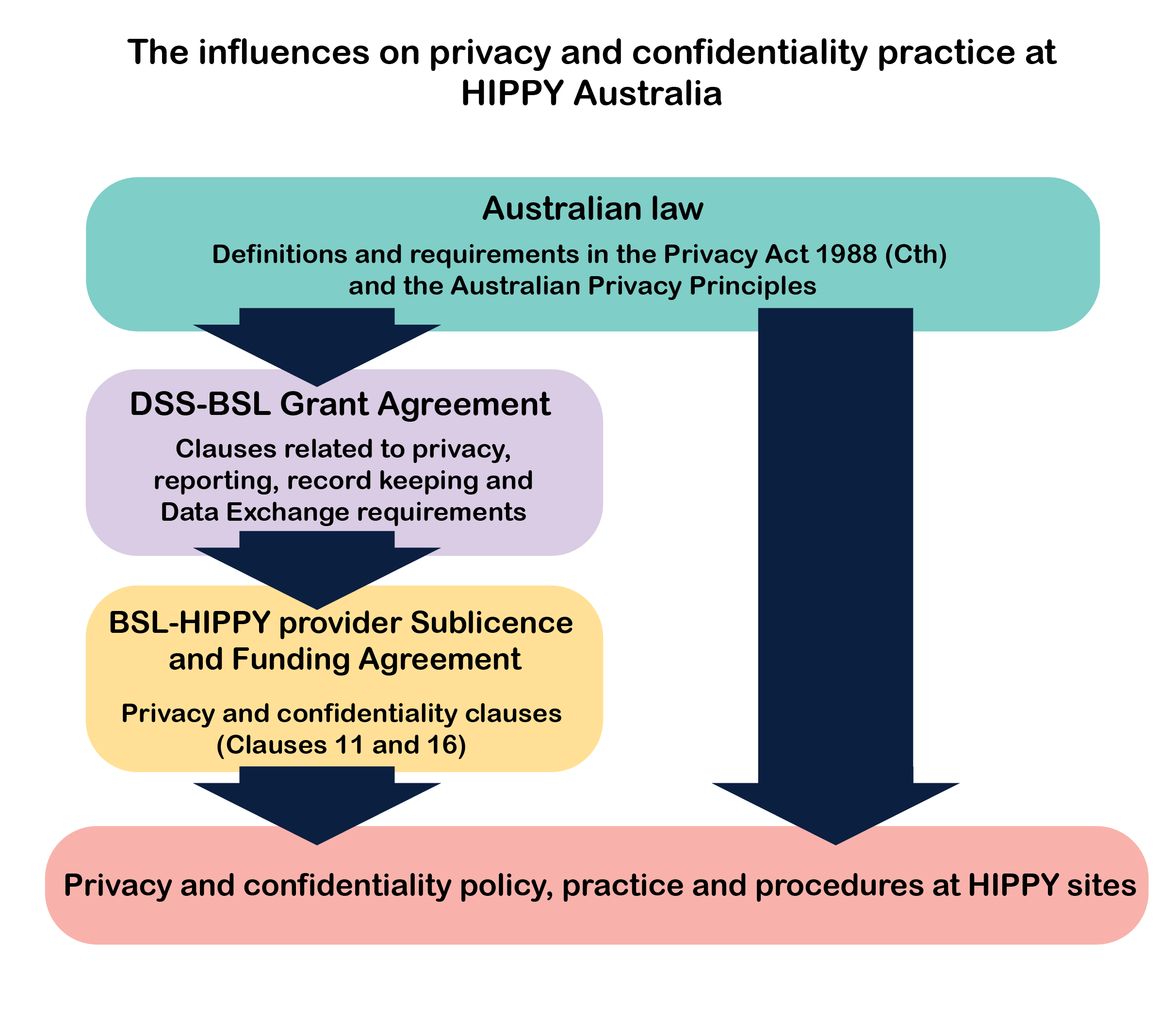
Providers also have important privacy and confidentiality responsibilities. Each organisation must follow its own internal privacy policies first and must also ensure compliance with the Privacy Act 1988 (the Australian Privacy Act), Australian Privacy Principles (APPs), the HIPPY Sublicence and Funding Agreement, and DSS privacy requirements. Protecting privacy is a shared responsibility - and essential to building trust with families and delivering HIPPY safely and effectively.
What is privacy and confidentiality?
Privacy and confidentiality are closely related but they are not the same. Understanding the difference helps ensure we meet our legal and contractual obligations.
Privacy
Privacy refers to individual’s right to control their personal information—including who can access it, how it is collected, how it is used, and when it may be shared. Privacy is a human right and legal requirement.
Information privacy is key part of this right and is especially important in HIPPY. It relates to an individual’s ability to decide when, how, and for what purpose their personal information is handled by others. Because HIPPY collects significant information from HIPPY families and staff, we must remain aware of our obligations to protect their privacy and that we clearly explain their rights, including how their information will be used and stored.
Confidentiality
Confidentiality is an obligation to protect information from being shared with anyone who is not authorised to receive it. In HIPPY, confidentiality means that HIPPY Australia and HIPPY providers take all reasonable steps to ensure personal information is recorded, used, and shared ONLY for the purposes for which it was collected, and never in ways that families or staff did not consent to. This includes following organisational privacy policies, HIPPY policies, and legal requirements to ensure all confidential material, whether written, digital, spoken or observed, remains secure and protected from unauthorised access or disclosure.
Who is responsible for maintaining privacy and confidentiality? While organisational leadership is responsible for developing, approving and implementing privacy and confidentiality policies, everyone involved in delivering HIPPY has a role to play. Maintaining privacy and confidentiality is a shared responsibility and essential to keeping families, staff and communities safe. |
Need to know definitions
The Australian Privacy Principles and handling of personal information
The Privacy Act 1988 is a law that outlines how personal information is to be protected, regulating how the government and private organisations collect, store, use and disclose that information. Included in the Act are the Australian Privacy Principles (APPs) that govern the rights, standards and obligations around how data is collected, stored and used.
The Australian Privacy Principles
The Privacy Act includes the 13 Australian Privacy Principles (APPs) which outline the rights of individuals and the responsibilities of organisations when handling personal information.
Under the Privacy Act, most businesses that handle personal information) must comply with the 13 APPs.
Both the Brotherhood of St. Laurence (BSL) and HIPPY provider organisations must adhere to the APPs.
The 13 APPs are legally binding and apply to all environments—digital and paper-based.
As organisations that have to follows the APPs, all HIPPY providers must have a clear and accessible privacy policy that covers:
- why personal information is collected (APP 6),
- what types of information are collected (APPs 3 and 5),
- how information is kept safe (APP 11),
- how information may be used or disclosed (APP 6 and 7), and
- how individuals can access, correct or update their information (APPs 12 and 13).
HIPPY Australia, as part of the BSL, abides by the BSL’s privacy policy . Along with Privacy Act 1988 and APPs, this policy guides how we manage personal information and how we respond to enquiries that come through the HIPPY Australia website, email inbox, or other channels.
Privacy and confidentiality in practice – staying compliant with privacy laws
Now that we have mentioned the ‘big picture’ foundations of privacy and confidentiality that need to be complied with at our organisations, it’s also important to explore what adhering to these requirements looks like in practice. In this section, we are including practical steps and tips to support you to keep families informed, confidential information secure, and know what to do if confidential information is disclosed inappropriately.Privacy when working with families
When working with families at sites it is important to consider the following to ensure we meet our privacy obligations:
Photo, video and story permissions Photos, videos and stories are personal, and staff must seek permission from parents to use stories and images featuring their family. Written permission forms must be collected from every individual depicted, using the correct media permission form for the intended use. Coordinators and Tutors should be clear in explaining how the images and stories are to be used and also make sure that parents understand the extent of their permission, including the option to retract permission if they change their minds. Even when you have signed permission forms, it is always good practice to check with parents and carers before using images of them or their children, particularly when they will be seen by the general public. Coordinators are responsible for securely storing permission forms along with the images or stories. Coordinators should contact individuals as a courtesy when their material is being used. Note: Please make sure to check your own organisation’s policies on photos and privacy as they may have additional requirements. When submitting images and stories to HIPPY Australia/BSL, families must have completed a HIPPY Australia media permission form. This is separate to its usage by HIPPY providers. To support privacy, HIPPY Australia applies a two-year lifespan to any image or story involving people; permission must be renewed to continue using the material. |
Privacy when working at the office and in the community
Your work practices in the office and out and about in community have a significant impact on privacy and the security of confidential information. To meet our privacy obligations, it’s important to consider the following areas.
Working in the office
Working out and about in the community
Being out and about in the community, personal information has a greater chance of being disclosed to people it’s not intended for—an overheard conversation, laptop or tablet left open in a library or café, or papers left around the house can all present opportunities for personal information to be accessed by people it’s not intended for.
Below are some good practices to take on when out in community.
Privacy and data breaches
What to do in case of a suspected data breach – a brief overview
HIPPY Coordinators and Line Managers should familiarise themselves with the HIPPY Australia critical incident guidelines to ensure that they understand the steps they are required to take if and when a data breach occurs. The guidelines cover a whole range of critical situations, including data breaches and should be followed along with providers’ own privacy procedures.
If there is a data breach or suspected data breach at your site:
- The breach or suspected breach should be immediately reported to the HIPPY Line Manager
- The Line Manager assesses the seriousness and significance of the breach, considering the potential harm it could cause
- The Line Manager reports the breach or suspected breach to their HIPPY Australia Site Advisor within two business days (as required by the HIPPY Australia critical incident guidelines)
- HIPPY Australia informs the Department of Social Services of the breach
- HIPPY Australia assists your organisation to determine if follow-up or investigation is required, seeking additional information, and supports development of a critical incident plan/data breach response plan
- The HIPPY provider reports the breach to the Office of the Australian Information Commissioner (if required by the Notifiable Data Breaches scheme).
- Your organisation and HIPPY Australia review the situation and develop and implement a prevention plan to ensure similar incidents don’t happen in the future.
More information on data breaches, when to report them and how to respond to them can be found on the Office of the Australian Information Commissioner’s website .
FAQs
Within each Bulletin we’ll now be answering sites’ questions on the edition topic.
Next edition's topic is insurance.
Send your questions through to hippyaustralia@bsl.org.au with the subject ‘Compliance Bulletin FAQs’ to be included in the next edition!
HIPPY Compliance
HIPPY Compliance Bulletin library